Pages

Thursday, May 07, 2015

हेटी ले सिकाउने: घुस खाने कि तलब खाने?


Hello, Jajarkot! No worries. I’ve sent doctors and drugs. They’ll arrive in a couple of years!

How not to rebuild Nepal
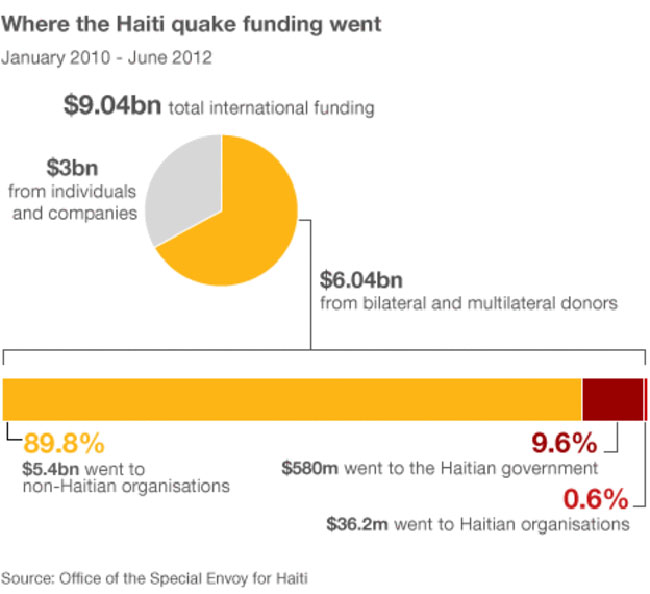
Last Saturday, I watched with the rest of the world as images emerged in the wake of Nepal’s violent earthquake: the dusty faces of survivors, bloodied bodies, the ruined historic buildings. It reminded me of the devastation I witnessed after the earthquake in my homeland, Haiti, five years ago — and it made me worry about what will come next in Nepal.......... I hope that they will be able to avoid the grave mistakes made by Haitians and by the well-intentioned donors who came to our aid. ..... here were two disasters in Haiti: the earthquake, and then the humanitarian crisis that followed. More than $10 billion in foreign aid still hasn’t enabled our country to recover from this disaster. ...... Most aid projects in Haiti promised “community participation,” yet most failed to truly include local people. What happened with housing provides a clear example. Many aid groups insisted on moving earthquake survivors who were living under tarps into “transitional shelters.” They ignored the objections of Haitians, who feared the flimsy plywood structures — prone to leaks and collapse — would become their permanent homes. Aid groups spent more than $500 million on these transitional shelters,” but have built less than 9,000 new long-term houses. Tragically, yesterday’s “temporary” shelters have become today’s permanent slums. ........ Many aid groups sent well-meaning but barely trained volunteers and deployed foreign doctors and nurses to areas where skilled Haitian professionals were readily available. Of every dollar given to the earthquake response in Haiti, less than a penny went to Haitian organizations........ If these funds had supported local people and organizations, the money would have gone much further. ........ Most aid after the earthquake focused on the short term, often ignoring long-term needs, especially infrastructure needed to prevent humanitarian crises in the future. My country is still struggling to contain the largest modern outbreak of cholera in history. The disease is thought to have been introduced by United Nations peacekeeping forces after the 2010 earthquake, but the crisis does not end there. This epidemic has continued largely because relief funds have unfortunately not been used to help Haiti build sufficient sewage systems. ............ Though coordinating aid seems like the most obvious thing to do, it didn’t happen in Haiti. Many aid groups clamored to support high-profile projects, which resulted in wasteful redundancies in some areas while allowing people in less well-known places to languish. Lack of accountability about foreign aid was the rule, with donors and Haitians receiving little news about how this aid was being spent.
हेटी २०१० बाट नेपाल ले सिक्नुपर्ने छ। सब भन्दा गड़बड़ गर्ने धनी देश हरु नै देखिए त्यहाँ। मेरो विचारमा समस्याको समाधान 100% Online Transparency नै हो। समस्याको समाधान बामे ले भने जस्तो सबै पैसा प्रधान मंत्री राहत कोष मा राख्ने भन्ने होइन। त्यसो गर्दा के हुन्छ नेपालको बच्चा बच्चा लाई थाहा छ। सबको मालुम है।


Media lessons for Nepal from Haiti: Don’t let outsiders seize control of the narrative
Expressions like ‘fragile state’ and ‘among the poorest nations’ were used by foreign powers to take control of the disaster response in Haiti in 2010. Nepal shouldn’t allow the same mistake. ...... each disaster has its own context, its survivors and citizens as first responders their own cultural understandings and priorities. Local people need to be in charge of the response. ..... At 4.53 pm on January 12, 2010, an earthquake of 7.0 magnitude struck outside Haiti’s capital, Port-au-Prince. The damage was unimaginable: an estimated 230,000 people died and equal numbers were injured. Over half the housing in the capital was seriously damaged; 105,000 houses were completely destroyed and 188,383 houses badly damaged, requiring repair. An estimated 1.5 million people lost their homes and stayed in makeshift Internally Displaced Persons camps. Though some of these numbers were subsequently contested, the Haiti earthquake became a transnational event because of foreign media coverage. For weeks it dominated the airwaves and cyberspace. ...... In the first week, private US citizens contributed $275 million, mostly to large NGOs like the Red Cross. ..... Sixty per cent of American households and over 80% of African-American families donated to the Haiti quake response, despite feeling the pinch from the global financial crisis. Worldwide, individuals donated $3.02 billion. ........ In the US, media stories abounded of first-time mission trips, almost invariably to celebrate the hometown heroes. Many of these narratives extolled Haitian people’s spirituality and resilience, at times to justify less aid. The returning heroes, now newly-minted experts, spoke about the virtues of Christianity, of capitalist development, public health and hygiene, and limited representative democracy – all markers of assumed cultural and racial superiority. The collective residues of these stories justified, and naturalised, foreign control of the country. ........ The New York Times columnist David Brooks, for instance, argued that Haitian culture was resistant to progress. ..... After the earthquake, the familiar language of Haiti being a “fragile” or “failed” state, which is among “the poorest in the hemisphere”, served to justify the need for foreign intervention as well as a convenient explanation for the limited progress of this intervention. ....... By focusing on “deficient” local cultural practices, social systems and institutions, the foreign media diverted attention from how foreign policies had played a role in amplifying the quake’s destructiveness. In processes similar to Mumbai, the population of Port-au-Prince had quadrupled after the World Bank, International Monetary Fund, and United States Agency for International Development began promoting neoliberal economic policies there. Coupled with the erosion of state capacity, neoliberalism contributed to Haiti’s “vulnerability” to the disaster. ..... Haiti-as-a-failed-state is within the frame, while foreign imposed neoliberalism is outside. Similarly, heroic acts of foreigners are highlighted, whereas Haitian people are outside the frame, dehumanised and infantilised. ....... First, the discourse of a “weak state” served to justify foreign control of the process and near-total exclusion of Haitian people from it. Second, this exclusion, having roots in framing Haitian people out of the story and tropes of dehumanisation, led to practices and relationships wherein

aid recipients felt treated like animals

. Third, the disaster response was greatly influenced by the “photo op”, prioritising high-visibility and high-cost “solutions” at the expense of those more sustainable. Finally, a “blame game” led to increasingly severe responses, including increasingly violent forced evictions.

Wednesday, May 06, 2015

प्रचण्डं र बामदेव बीच देखिएको समानता


हुन त त्यो समयमा प्रचण्डले शाही सेना र जनमुक्ति सेना ले मिलेर मधेसी क्रांति लाई दबाउनु पर्छ भन्ने अभिव्यक्ति दिएकै हुन। बीचमा ३० दलीय गठबन्धनको क्षणिक नौटंकी चल्यो। अब फेरि ३ दलीय पहाड़े/बाहुन गठबंधन आइहाल्यो। जुन आउनु नै थियो -- देर है अंधेर नहीं।

प्रचण्डं र बामदेव ले सत्तामा हुँदा पालै पिलो मधेसी राष्ट्रपति को अपमान गरे जस्तो। जब कि यो हुन ढाका टोपी लगाउने, एक जना पनि मधेसी सल्लाहकार नभएको मधेसी राष्ट्रपति। प्रचण्डले प्रधान मंत्री हुँदा आफ्नो कैबिनेट मा रहेका मधेसी हरुसँग छलफल गर्न उचित ठानेनन् , संविधानले भने अनुसार राष्ट्रपति मार्फ़त गएनन --- सोझै नेपाल सेना को प्रमुख आफै एक्लै निर्णय गरेर फाल्छु जस्तो गर्न थाले। त्यहाँ ethnic prejudice देखियो। अहिले आएर बामेले त्यही गर्यो। देशमा इमरजेंसी लागु गर्ने भनेको राष्ट्रपतिले हो --- प्रधान मन्त्रीले सल्लाह दिने अनि राष्ट्रपतिले लागु गर्ने। तर बामेले देशमा राष्ट्रपति नभा जस्तो गर्यो। कानुनी रुपले हेर्दा देशमा इमरजेंसी लागु नै भएन। प्रक्रिया मिलेन। होइन यदि लागु भएको हो भने त्यति बेला पनि प्रचण्डले सेना प्रमुख फालेकै हुन।


हाम्रो राष्ट्रपतिको किन मानमर्दन गरिस भनेर काँग्रेसी हरु जंगिनु पर्ने --- उल्टै त्यसलाई सानो कुरा, बरु डाक्टर राष्ट्रपति स्वास्थ्य उपचारमा लाग्नु पर्ने भन्दै छन ---- अर्थात racism र ethnic prejudice को कुरामा आफ्नो पार्टीको मान्छे भन्दा अर्को पार्टीको बाहुन सहयात्री।

मधेसी मातृका मंत्री हुँदा उसको पियोन ले अपमान गरेको हो। न्यू यॉर्क मा मधेसी मंत्री लाई कांसुलेट को ड्राइवर ले lack of respect देखाएको मैले देखेको छु।

भर्खरै देशको राष्ट्रपतिलाई जाबो एउटा गृह मंत्री ले अपमान गर्दियो। राष्ट्रपतिको अगाडि संविधानको हकमा मर्यादा क्रम मा गृह मंत्री भनेको ड्राइवर र पियोन जस्तै होइन?


The Government Under A Cloud

Could Nepal’s messy politics hamper relief efforts?
Big earthquakes happen in Nepal roughly once a century. More than 7,000 died in the last one in January 1934, a life-defining caesura for those old enough to remember it ..... Nepal’s ability to co-ordinate efforts unfortunately look likely to be hampered by unresolved political issues and a lack of strong leadership. ..... It might be tempting to think that delays over writing Nepal’s long-awaited constitution don’t matter, that life can go on as normal without political resolution (and many Nepalis, bored with the games of political musical chairs in Kathmandu, had begun to think just that). But the earthquake shows just how vital it is to have political institutions that work, both at the centre and, even more importantly, at the local level. ..... Panchayat rule was milder than the preceding Ranas – it was more nationalist and developmentalist and spoke the language of democracy and equality. But it was ruthless with opponents, banned political parties, and, in practice,

institutionalised ethnic and social exclusion

...... Even when hostilities ceased and parliament was reinstated, the old game of sharing the spoils in a series of coalition governments continued. The hard work of thrashing out what a new reconstructed federal state would look like was repeatedly put off to the last minute. ..... Earlier this year, the prime minister himself torpedoed any chance of compromise and the timely declaration of a new constitution, as success would have meant handing over his job to his UML counterpart, as part of a coalition deal. ..... The fact that Koirala is 75 and and physically weak does not help in producing a vigorous response to the crisis. The lack of strong, co-ordinated leadership at the top is evident. ..... Apart from coming up with a constitution, there is a great deal of unfinished business from ten years of civil war, which will inevitably be put off still further by this natural disaster. One important example is the Truth and Reconciliation Commission which is supposed to look at serious human rights abuses that occurred during the war. Another, which really should have been dealt with by now, is local elections.
उद्धार र राहतमा भेदभाव भएको छैन: सरकार
पछिल्ला खोज तथा राहत काठमाण्डू, गोरखा र सिन्धुपाल्चोकमा बढी केन्द्रीत रहेको भन्दै अति प्रभावित दुर्गम पहाडी गाउँहरुमा पनि राहत पुर्याउनुपर्ने आवश्यकता औल्याएको थियो। .... अबको ६ हप्तापछि सुरु हुने भनिएको वर्षायाम अघि नै भूकम्प प्रभावित सबै स्थानमा दिगो उद्धार तथा राहत पुर्याइसक्नुपर्ने जोड राष्ट्रसंघको रहँदै आएको छ।
सहयाेग रकम दातृ निकाय आफैं खर्च गर्ने धुनमा
मुलुकलाई राहत र पुन:स्थापनाका लागि रकम आवश्यक भइरहेका बेला अधिकांश दातृ निकाय भने सिधै गैरसरकारी संस्थामार्फत खर्च गर्न खोजिरहेका छन्। सरकारले सहयोग रकम प्रधानमन्त्री दैवीप्रकोप उद्धार कोषमा दाखिला गर्नुपर्ने अनिवार्य व्यवस्था गरेपछि लबिङमा लागेका दातृ निकायले सोमबार परराष्ट्र मन्त्रालयमा भएको छलफलमा यसलाई प्रमुखताका साथ उठाएका थिए। ..... दातृ निकायले हालसम्म रकम कबोलेर करिब ३ अर्ब रुपैयाँबराबरको प्रतिबद्धता जनाइसकेका छन्। तर, कुनै पनि रकम प्रधानमन्त्री दैवीप्रकोप उद्धार कोषमा जम्मा भइसकेको छैन। सरकारले अहिले मुलुकभित्र दुई वा दुईभन्दा बढीबाट उठाइने रकम र विदेशी सहायता कोषमार्फत परिचालन गर्नुपर्ने व्यवस्था गरेको छ। दातृ निकायले अनौपचारिक रूपमा सरकारको खर्च गर्ने संयन्त्र कमजोर भएको र जवाफदेहिता पनि नरहने दाबी गर्दै कोषमा रकम दाखिला गर्न चाहिरहेका छैनन्।
Nepal's disastrous politics could hold back its recovery
Over the past nine years, Nepal has had eight prime ministers. The country still has no permanent constitution. And the same vested interests that once shaped its civil war, have become entrenched once again in its politics.
Bureaucratising relief
according to one international rescue and relief worker, in the four days after the earthquake, over 200 international teams had arrived in the country. Coordination for any functioning government would be an uphill challenge. ...... But this is not just ‘any government’ and it has never been the most ‘functioning’ even before the earthquake ....... an issue of a ‘lingering lack of governance’ ..... The state, based on inherited feudal structures and cultures of government, has built upon and expanded patronage networks prioritising the distribution of state funds among elites (read the now resurrected all-party-mechanisms [APM]) and has continued to treat inhabitants as subjects and not rights-bearing equal citizens. ........According to an international relief worker, in the immediate days following the earthquake, the Israeli rescue and relief team had been ready to take off in its helicopter at the airport at 6.30am. However, they were made to wait until 9am when the bureaucrat whose signature they required to be able to fly in the helicopter, arrived for work. Such permissions are still required on a day by day basis. When every second counts to save lives, especially in the early days of rescue, the feudal state mechanisms ambled, and ambles, on; literally causing death by bureaucracy. ......... The same feudal logic informs the holding up of vital relief supplies at the airport. Home Ministry spokesman Laxmi Prasad Dhakal is quoted as saying the inspection of all goods from overseas “is something we need to do”. At a time of emergency, that what the government ‘needs to do’ is save lives appears to be missed. An international source stated that a few days ago, a Japanese team had arrived ready to spring into action at 7am but were forced to wait until they received their goods 12 hours later. How many lives could have been saved in that time? ....... Official clarifications that organised relief materials and ‘individual’ relief materials are not taxed, but the latter require additional paperwork and post-work confirmation have been useful. However, doubts have been raised on the actual implementation of these rules. That taxes on tents and tarpaulins were only lifted on Friday raises the issue of how Nepali custom officials had defined relief materials before this date and what had and had not been consequently taxed. There are reports from the eastern part of the Tarai of taxation on relief materials crossing the border by land. ....... “The taxes the state is forgoing is not trivial…It wants to ensure that the implicit state subsidy is targeted towards genuine relief. Do not underestimate the scale of cheating that goes on when there is no monitoring or voluntary code of honour in place.” .......

here the ‘business as usual’ mentality holds sway in the face of the biggest tragedy the nation has faced in decades. Concern over loss to the national treasury trumps the need to save lives. Underlying the monetisation and clear devaluation of people’s lives is the logic of a state that seeks not to serve citizens, but to accumulate power to justify its existence along feudal lines of authority.

...... “Lying by the road in the village was a pile of supplies under tarpaulins. These had been delivered by the government the previous evening. However, the officers at the small police station there had not been authorised to distribute them, so they lay untouched.” ........ it has been the internationals and the non-state sector (with the exception of the Nepal Army) which have played key roles in responding to the needs of the people. With few exceptions, the state has so far performed miserably in the aftermath of the earthquake. While there is a real need to not undermine state authority, and indeed to build state capacity, it must be made clear that rebuilding/strengthening a feudal state is not the goal. The feudal legacy embedded in an antiquated bureaucracy and reinforced by a political elite centered on power and its preservation, must be fiercely critiqued and resisted by all citizens. Prioritisation of the lives of citizens—not the policing of restrictive rules in a time of emergency—should be central. The expedient delivery of relief materials from the airport and other locations to citizens in need must take precedence.

In The News (5)

Nepalis in New York Improvise a Relief Effort for Earthquake Victims
Most Nepalis here have sidestepped the major international humanitarian organizations, which many view as slow or inefficient. Nearly all have avoided the Nepali government, calling it ineffective and corrupt. They have instead sent money and goods to their homeland through grass-roots Nepali groups, or directly to relatives and friends...... the largest enclaves in the Queens neighborhoods of Corona, Elmhurst, Jackson Heights, Ridgewood, Sunnyside and Woodside, as well as in Midwood in Brooklyn ..... In recent days, Western aid organizations and governments complained that Nepali bureaucratic procedures were holding up relief supplies at the Kathmandu airport. Representatives of Heartbeat have sent a request through their social media networks that travelers bound for Nepal consider using part of their luggage allotment to carry relief supplies.
Nepal’s Young Men, Lost to Migration, Then a Quake
When the dense pillar of smoke from cremations by the Bagmati River was thinning late last week, the bodies were all coming from Gongabu, a common stopover for Nepali migrant workers headed overseas, and they were all of young men. ...... The countryside was largely stripped of its healthy young men even before the quake, as they migrated in great waves — 1,500 a day by some estimates — to work as laborers in India, Malaysia or one of the gulf nations, leaving many small communities populated only by elderly parents, women and children. Economists say that at some times of the year, one-quarter of Nepal’s population is working outside the country. ...... unless the government acts swiftly to create work opportunities at home, the exodus of young people will accelerate after the relief operation ends, permanently handicapping the country’s ability to rebuild. ..... The Gongabu neighborhood was one of the deadliest places in Kathmandu. It is an area where recruiting agencies housed young village men awaiting work overseas, with several thousand budget hotels and guesthouses crammed in lanes near the long-distance bus station. ..... The scale of the economic migration from Nepal has amazed development economists for many years. ..... Today, manufacturing contributes only 6 percent of the country’s gross domestic product ...... The earthquake will make things much harder for the country’s poorest people, especially in rural areas where most Nepalis live. ..... The tourism industry, which had been growing and contributing about 9 percent of the country’s output, is now expected to drop off sharply. ..... many will decide that they can best help their families by going abroad and sending their earnings home
With Monsoon Nigh, Tent Shortage After Nepal Earthquake Prompts a D.I.Y. Response
The monsoon is expected in about three days. ...... An entire Toyota dealership is now assembling tents — one every minute....... The estimated need is for 500,000 tents by the end of the week. The government thinks that with current supplies they can obtain 300,000 rectangles of canvas, and are uncertain where the rest will come from. ...... There is no immediate solution for permanent structures that will be needed for the coming winter
Amid Katmandu’s Earthquake Wreckage, Hints of a Shift to Safer Construction
Progress would be a good thing, because this earthquake is not nearly Katmandu’s “big one.” A closer quake of similar magnitude is inevitable, although seismologists cannot say how soon...... In 1960, a 9.5-magnitude earthquake struck Chile, after which the country embarked on a massive earthquake-safety program and enforcing new building codes. By contrast, Haiti did nothing during this period, lulled into complacency by a lack of seismic activity and hampered by constant political unrest and extreme poverty. ..... “only about 10 percent of the country’s buildings are designed by engineers – and they typically aren’t even at the construction site as their building rises.” ...... “In an environment of poverty and corruption, rigorous building codes do more harm than good.”

In The News (4)

Video: Bamdev Gautam


Nepal, Before and After the Earthquake
The accounts hint at the trauma of seeing an environment mostly taken for granted as stable and secure suddenly disintegrate. There was the house that fell on a little girl who had just walked inside to fetch water. There was the nursing mother who looked up and saw the unthinkable: “The hills all came down.” ...... scientists project that this residual shaking could continue for years.
Indian media criticized for 'insensitive' coverage on Nepal quake
Hours after Nepal was shaken by its biggest quake in decades, India rushed to the rescue -- its army, air force, and rescue teams were applauded for their nimble and generous response. ..... Local news channels have been proudly trumpeting that they were the first ones to reach "Ground Zero" and to bring "exclusive" reports to households in India and across the world. ...... Indian journalist Indrani Bagchi argued that it's unfair to criticize India's media with one brushstroke -- if it wasn't for India's media, many of the stories of what's happening in Nepal would go untold ...... "Indian media coverage has been largely responsible for how the rest of the world sees the Nepal tragedy. Even driven global response. Even if it is slightly over the top sometimes"
India's TV journalists have damaged our relations with Nepal
For years, Indian journalists reported stories about “big brother India” in Nepal, and how Delhi’s policies towards its northern neighbour often resembled the third degree being meted out to a recalcitrant, moody, stubborn child who simply refused to listen. ....... This patronising treatment was primarily the prerogative of Indian diplomats posted in that Himalayan nation, and it was no coincidence that the ambassador was often called the “Viceroy”. ..... God forbid you were seen in public with an Indian diplomat; it was as if your credibility was already suspect. ...... Some of the Nepali reaction was certainly justified — remember the time, a few years ago, when the Indian ambassador applied enough pressure on Indian companies to pull advertisements from Nepali newspapers because he didn’t like the line they were toeing? ..... Certainly, the visiting Indian tourist, who behaved abominably in the bars and restaurants of Thamel or in casinos elsewhere in the city, reconfirmed the ‘Ugly Indian’ epithet that the poorer Nepalis applied to them. ...... There was an intimate dislike between Indians and Nepalis — precisely because both citizenry shared language and religion and colour of skin. ...... Having gone there to cover the earthquake and show solidarity with the pain and trauma of those who had suffered, several Indian TV journalists instead behaved like callous and insensitive jerks, one of them repeatedly asking a woman who had lost her young son: “How do you feel?” ...... It’s enough to make you throw up. The exact same thing happened in the Kashmir floods in September last year. Some TV journalists got into boats that the National Disaster & Rescue Force (NDRF) had employed to rescue residents of Srinagar, and, thrusting their mics in the face of traumatised people, asked: “Are you grateful that the Indian army/air force/NDRF are rescuing you?” ...... When some Srinagar residents shouted back into the cameras: “We are Indians too, we don’t need to be grateful,” the TV journalists replied by reporting that Kashmiris had divided loyalties towards Pakistan. ..... Several Nepalis have caustically pointed out how several Indian journalists reporting the Nepal earthquake behaved as if the people’s trauma was only a sideshow to the “amazing” help that the Indian government in general, and Prime Minister Narendra Modi in particular, displayed towards Nepal. ...... No wonder Doval and Jaishankar — and joint secretary in the Prime Minister’s Office, Javed Ashraf — flew into Kathmandu a few days ago to reiterate the message, that Nepal was leading the entire operation and India would only help Nepal as long as Nepal wanted help. The fact of the matter is that the NDRF has specially exhibited such sterling service that it has left every other country far behind. India is the only country that doesn’t have the name “India” emblazoned on every tent, every all-weather jacket, every milk tin, every grain bag that is being flown into Nepal. Every other country — whether China, the US, Israel, Britain as well as every two-bit Scandinavian do-gooding nation as well as NGO — is behaving like they’re there to “save the people”.


The Glory That Was Hippie-Era Kathmandu Finally Died in the Nepal Earthquake
60% of all heritage buildings were “badly damaged” in the quake. With them, a whole way of life has finally vanished. ..... The Kathmandu valley lies at an ethereal altitude of 4,600 ft. (1,400 m), and, besides the natural beauty of the encircling Himalayas, boasts some 130 monuments, including several Hindu and Buddhist pilgrimage sites, and seven UNESCO World Heritage sites. Or perhaps we should say “boasted.” ...... The 1975 Bob Seger classic “Katmandu” immortalized the escapist allure of Kathmandu. “I’m tired of looking at the TV news,” sang Seger. “I’m tired of driving hard and paying dues/ I figure, baby, I’ve got nothing to lose/ I’m tired of being blue/ That’s why I’m going to Kathmandu.” ...... Goodman, a 67-year-old Ohio native, describes his time in the ancient Newar city of Bhaktapur, just 8 miles (13 km) outside Kathmandu, and where at least 270 people were killed in the most recent quake, as like “living in medieval Europe in the 13th century.” ....... “I used to wake up around 7 a.m. to the sound of birds at the window, distant temple bells and giggling girls at the water tap by my house,” says Goodman. “I’ve never woken to a nicer sound in my life.” ...... Those halcyon days began to fade towards the end of the 1980s. The government made visas harder to obtain, and many long-term expatriates, like Goodman, were strong-armed into departing. The Iranian Revolution and civil war in Lebanon made the old overland route to Nepal far more difficult. New arrivals had to come by air, and thus needed deeper pockets. Later, Nepal’s own civil war, which raged from 1996 to 2006, deterred many visitors. ...... Today, income inequality has soared and land values within the Kathmandu ring road rival those of New York City ...... While the trickle down of tourist dollars has helped some, particularly the Sherpas, “marginalized groups who are not in the trekking areas do not receive any of the benefits” ........ And once all the rubble has been cleared (or looted), there seems almost no chance that the traditional but vulnerable red brick and timber structures will return. The old city will be rebuilt in reinforced concrete and hippie Kathmandu will become merely a memory. The Kathmandu of an even earlier era may not return either.
Recovery In Nepal
One view holds that no government could have dealt with a crisis of this magnitude, let alone Nepal’s ....... Nepal is in a seismically vulnerable zone, the government should have been better prepared. No one disputes the contributions of foot soldiers in the rescue effort, but there is obvious frustration with the government response. Reaching out to all locations immediately may not have been possible, but there is emerging criticism of the government’s actions in the first three days, when rescue needs were most acute; its neglect of rural regions; its failure to have stockpiled basic supplies; the inertia of political parties that have not been on the ground helping citizens; and the government’s confusing and contradictory directives on requirements for receiving international assistance. ........ There have already been protests of Prime Minister Sushil Koirala’s management of the crisis. Koirala, who was in Bangkok when the earthquake struck, reportedly received the news from Indian Prime Minister Narendra Modi’s tweets. Delhi, meanwhile, has been a remarkably energetic first international responder. By the Thursday after the earthquake, India had sent five hundred and twenty tons of relief materials, eighteen medical teams, eighteen engineering teams, and sixteen disaster-relief teams. India also sent National Security Adviser Ajit Doval and Foreign Secretary Subrahmanyam Jaishankar for a ground-level field assessment. An editorial in the Kathmandu Post, Nepal’s leading English-language daily, noted that the hashtag #ThankPM was trending on Twitter, and caustically commented that it was, in fact, to thank Modi. ........ The debate about the Nepalese government’s capacity and effectiveness has real policy implications: it will help determine the balance of power between the state and other actors when it comes to determining relief priorities, distributing aid, and working on a long-term reconstruction plan. Nepal’s finance minister, Ram Sharan Mahat, has said that the country will need at least two billion dollars to rebuild, and has issued an international appeal for help. The United States has pledged almost twenty-six million dollars; the U.K., 7.5 million; and the E.U., 3.2 million; there have also been pledges from individual European countries, and aid has been channelled through international N.G.O.s and private charities. These numbers are constantly changing as actors scale up their assistance. But the question is whether Nepal’s government is in a position to effectively coördinate the aid that is coming in and deliver it to those who need it. ......... Young people of Nepalese origin all over the world have been quick to start fund-raising initiatives. ...... the earthquake has brought Nepalese society together in ways that were difficult to imagine until last week, when a polarized political climate and deep social cleavages had almost eroded the ethos we shared and the sense of belonging we had
Use Data, Not Nepotism, to Deliver Aid in Nepal
On the day the earthquake hit, after finding out that relatives and friends in Kathmandu Valley were alive, I worked to connect volunteers and people affected by the quake, using low-tech solutions including a Google Doc and social media. As I helped crowdsource resources and needs, and read reports from the ground, it became apparent that there was little relief available for villages outside of Kathmandu Valley. When we look at the data coming out of the disaster so far, it’s clear that these villages need relief, too. ....... The data show that villages outside the Kathmandu Valley need aid the most, not just based on the lives lost and houses destroyed by this disaster, but also because historically people in the villages had less to start with. ..... For instance, in Nuwakot, a district about 60 miles northwest of Kathmandu, about 45,000 houses have reportedly been destroyed or damaged. According to Nepal’s 2011 census, there are about 59,000 households in that district. That means that potentially only one in four houses are left intact in Nuwakot. Yet only about 1,300 people in the district have been reported injured by the earthquake—a figure that’s likely underreported. ....... we have been regularly updating an interactive map of the effects of Nepal’s earthquake. It uses district-level data to show injury tolls, death counts, and houses damaged to determine where aid is needed the most.
Nepal’s Only Billionaire Begins His Own Earthquake Aid Program
Nepal’s richest man–noodle king Binod Chaudhary–said his group has already handed out hundreds of thousands of packets of Wai Wai noodles ...... His Chaudhary Group is Nepal’s largest conglomerate with revenues of more than $800 million. It has interests in everything from cement to hotels to supermarkets but its best known brand is Wai Wai. ..... The group sells about two billion packets of the instant noodles worldwide every year. ..... While many of the group’s 6,000 employees had to sleep outdoors for a few days, none were killed by the quake and its production facilities in the district of Nawalparasi, more than 100 miles west of the capital, were undamaged. ...... If Nepal doesn’t get back on its feet quickly, he said, there is a real danger that a lack of opportunities could trigger a new exodus of workers from Nepal. ...... More than two million Nepalis already work overseas—most of them in India and Persian Gulf countries—sending home the equivalent of close to 30% of the country’s gross domestic product comes in remittances.
NASA's Radar Found 4 Men Trapped in Rubble in Nepal By Their Heartbeats
After the earthquake hit, rescuers in the village of Chautara got two prototype units of the device called FINDER, or Finding Individuals for Disaster and Emergency Response. The core of the device is a system that bounces microwaves around to “see.” Crucially, it can discern faint heartbeats and breaths in people buried under several feet of rubble....... In this case, FINDER was apparently able to detect the heartbeats of two men each in two different collapsed buildings. The men had been trapped for days, under as much as 10 feet of rubble.
Rolling Stones' Jagger, Wood record Nepal quake charity single
Horror in Nepal's 'worst-hit' village
Why hasn’t more money been raised for Nepal earthquake relief?
Just over a week after the devastating earthquake, only 2 per cent of the $415M (U.S.) flash appeal has been pledged. ...... the problem is that there is only a limited amount of money available for humanitarian relief in the world, and an endless supply of crises. ...... when a 7.0 magnitude earthquake struck Haiti in 2010, aid flooded in from around the world...... the turmoil in the Middle East and Ebola in West Africa have taken their toll on the world’s coffers, and may have tilted the balance of available donors — mostly governments — away from Nepal. .... “The world’s kind of tapped out,” he said. .... global humanitarian expenses rose almost 30 per cent to US$22 billion in 2013. ...... Compounding the issue is that even when governments do pledge aid, it can take a long time to deliver. As of Monday, about 85 per cent of the money that has been raised for the flash appeal is still outstanding. ...And while countries across the world wait to send their checks, Nepal is running out of time... “Rapidly deteriorating weather conditions, as the monsoon season approaches, is likely to become an added logistical challenge to the provision of humanitarian assistance,” Doyle said.....“Funding is needed immediately to continue the relief operations.”

100% Online Transparency Not Just For Nepal Governemnt


Actually it might primarily be for foreign governments.

100% online transparency would show things like, look, US citizen, Binod Chaudhary built 10,000 homes and 100 schools with a 25 crore donation, but your government has spent 2500 crores and built only 5,000 homes ---- where did the money go?

Each declared donation would be directly linked to all the resultant specific projects on the ground.

The biggest donors are all democracies. They answer to their people. And their people will not know to ask the right questions unless they have the information. You build the pressure through 100% online transparency.

The NGOs doing the best work would surface up. And that would create an environment for them to raise more money to do more good work.